Structural Support
At Tree Care Enterprises, we offer expert structural support services to ensure the stability of your trees, preventing potential damage while maintaining their health and aesthetic value.
Tree Cabling and Bracing in Rockford, IL & the Surrounding Region
Some trees develop structural weaknesses that create risk — but aren't necessarily candidates for removal. Co-dominant stems with included bark at the union, long horizontal limbs extending over structures, and large mature trees with historical or landscape significance can often be retained safely with properly installed support systems. Tree Care Enterprises provides ANSI A300 Part 3-compliant cabling and bracing services to help valuable trees remain standing safely. We have served the Rockford and Lake Geneva areas since 1978.
When Is Structural Support Appropriate?
Not every weak branch needs a cable, and not every cable installation will save a failing tree. Our ISA Certified Arborists evaluate each situation individually, considering the species, size, and architecture of the tree; the nature and extent of the structural weakness; the proximity to targets (structures, vehicles, people); and the tree's overall health and longevity potential. The goal is meaningful risk reduction while preserving trees worth saving.
Common scenarios where structural support is appropriate:
- Co-dominant stems with included bark: When two roughly equal stems grow upward from a common fork with bark tissue trapped between them, the attachment is inherently weak and prone to splitting. A cable installed in the upper third of each stem limits the force of separation under wind and ice loading — a common threat in northern Illinois winters.
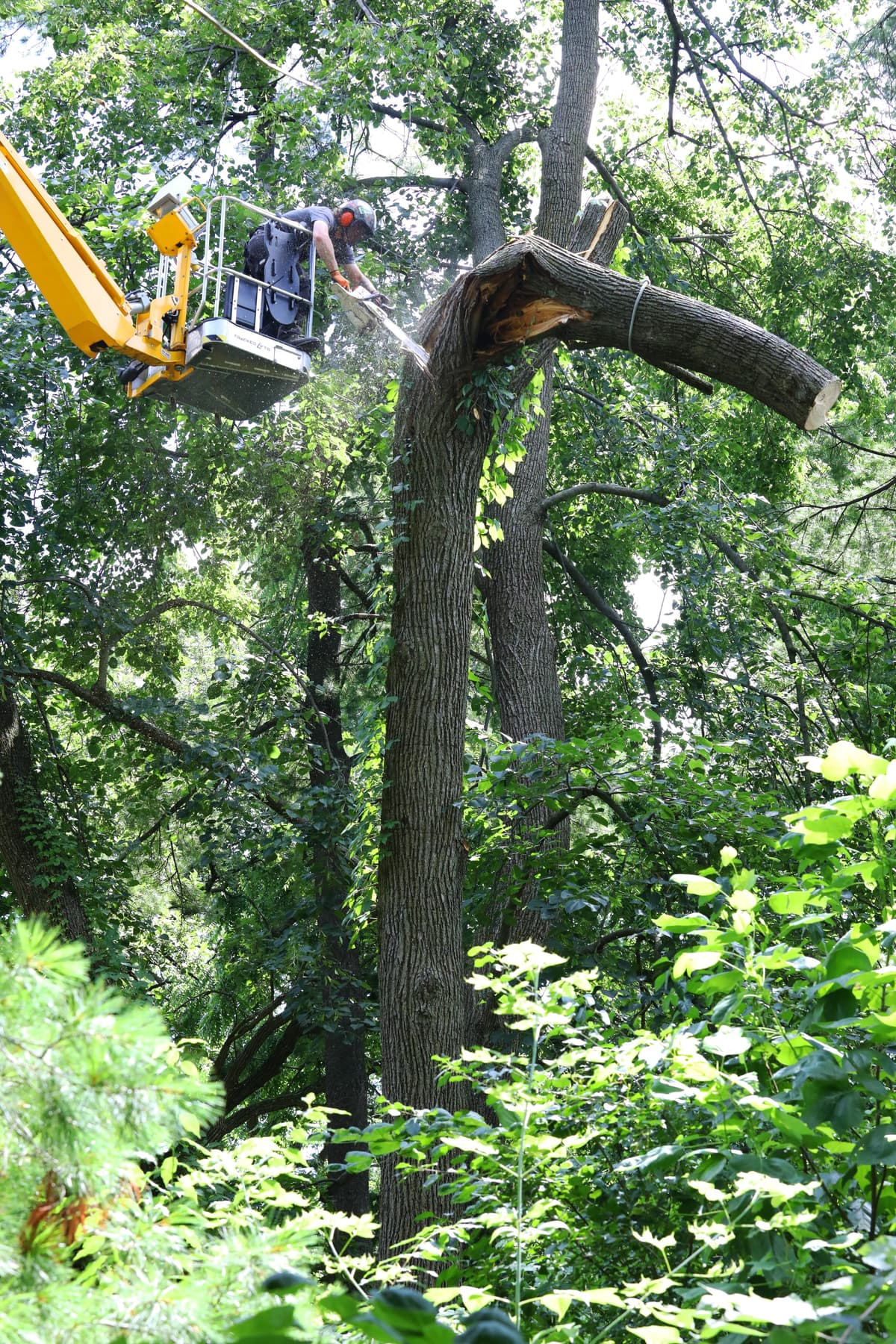
- Extended horizontal limbs: Large-diameter horizontal limbs on silver maples, oaks, and beech develop impressive canopy features over decades, but their own weight creates bending stress at the point of attachment. End-weight reduction pruning combined with a cable substantially reduces failure risk.
- Multi-stem ornamentals: Ornamental trees with asymmetric multi-stem growth can develop uneven mechanical load on stem attachments. Cabling preserves form while reducing the risk of stem splitting.
- Split crotches and existing cracks: Trees that have already begun to split can sometimes be stabilized with threaded rod bracing through the split, combined with cables above.
Types of Support Systems
- Steel Cable Systems: High-strength steel cables attached with through-bolts or eye-bolts provide rigid, high-load support. Best for severe structural defects requiring maximum load limitation.
- Cobra Dynamic Cabling: Synthetic braid systems that allow natural movement while limiting excessive sway. Less invasive than through-bolt installation and preferred when some flexible wind response is beneficial.
- Threaded Rod Bracing: Steel rods installed through split crotches or open cavities to hold split sections together. Often used in combination with overhead cables.
ANSI A300 Part 3 Standards
Tree Care Enterprises installs all cabling and bracing in compliance with ANSI A300 Part 3, the American National Standard for Tree Support Systems. This standard governs cable placement height (typically the upper third of the span between attachment points), hardware specifications, and inspection requirements. Properly installed systems should be inspected annually by an arborist, and hardware replaced when wear, corrosion, or tree growth around bolts is detected.
Our ISA Certified Arborists — John Richards (IL-0027A), Doug Edwards (IL-0505A), Matt Richards (IL-9831A), Jeremy Montana (IL-4690A), and Pete Montana (IL-4689A) — provide honest structural assessments and install systems built to professional standards. Tree Care Enterprises holds TCIA accreditation. Call 815-965-5757 to schedule a structural evaluation for any tree you're concerned about.